
Mobile app maturity and growth
Elevating credibility, feature parity, and consistency across Guideline's iOS and Android apps.
Client: Guideline
Role: Staff Product Designer
Date: Jan – Dec 2025
TL;DR
I led a comprehensive mobile maturity initiative that increased App Store ratings from sub-4.0 to 4.7+ while expanding feature parity and modernizing the design system foundation.
Overview
When I joined Guideline, the mobile app's adoption was steady but underperforming in perception and parity. App Store ratings sat below 4.0 (iOS: 3.8, Android: 3.5), the feature set lagged behind web, and the visual system was inconsistent with our newly launched Atlas design system. In fintech, credibility is critical: research consistently shows that users strongly prefer apps rated 4.0+ and that even small rating increases can materially impact download conversion and trust.
Over this time period, I led three parallel initiatives to improve perception, engagement, and product maturity:
Strategic ratings recovery
Multi-account + IRA expansion
Dark mode + full design system alignment
Mobile app experience audit
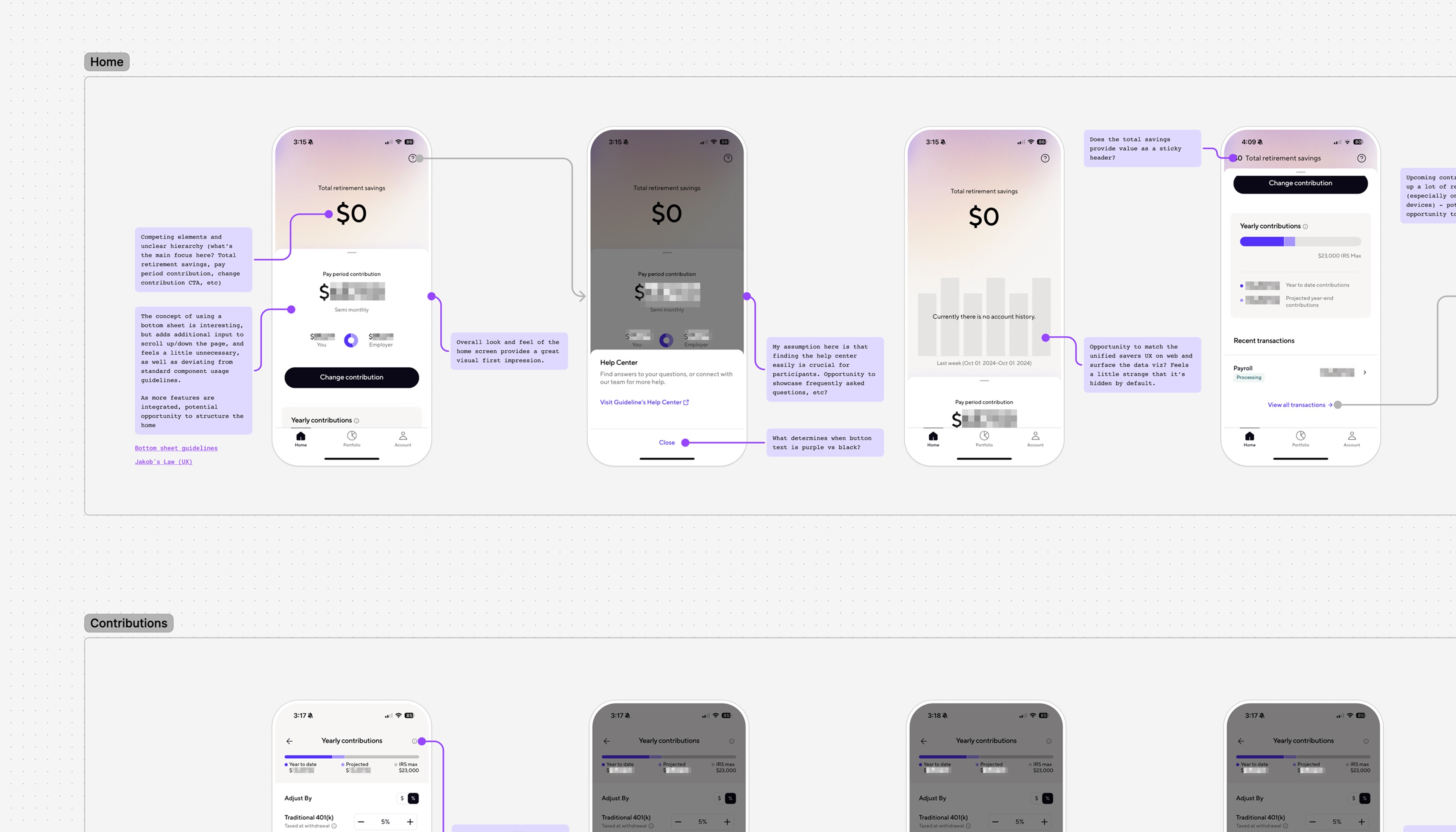
Before introducing new features, I proactively conducted a comprehensive audit of the entire mobile application, capturing and reviewing every screen. The goal was to identify design system inconsistencies, accessibility gaps, workflow friction, and long-standing usability issues. The audit revealed significant divergence from Atlas, our web design system, along with inconsistent typography, color usage, and interaction patterns across key user journeys.
Rather than treating these findings as isolated defects, I synthesized them into a structured quality framework and presented the opportunity space to product, engineering, and design stakeholders. From there, I partnered with my feature team to translate insights into a prioritized roadmap and created a clear engineering backlog to systematically address design debt and usability improvements. This established a shared quality baseline for mobile and positioned future work on a stronger, more scalable foundation.
Increasing App Store ratings
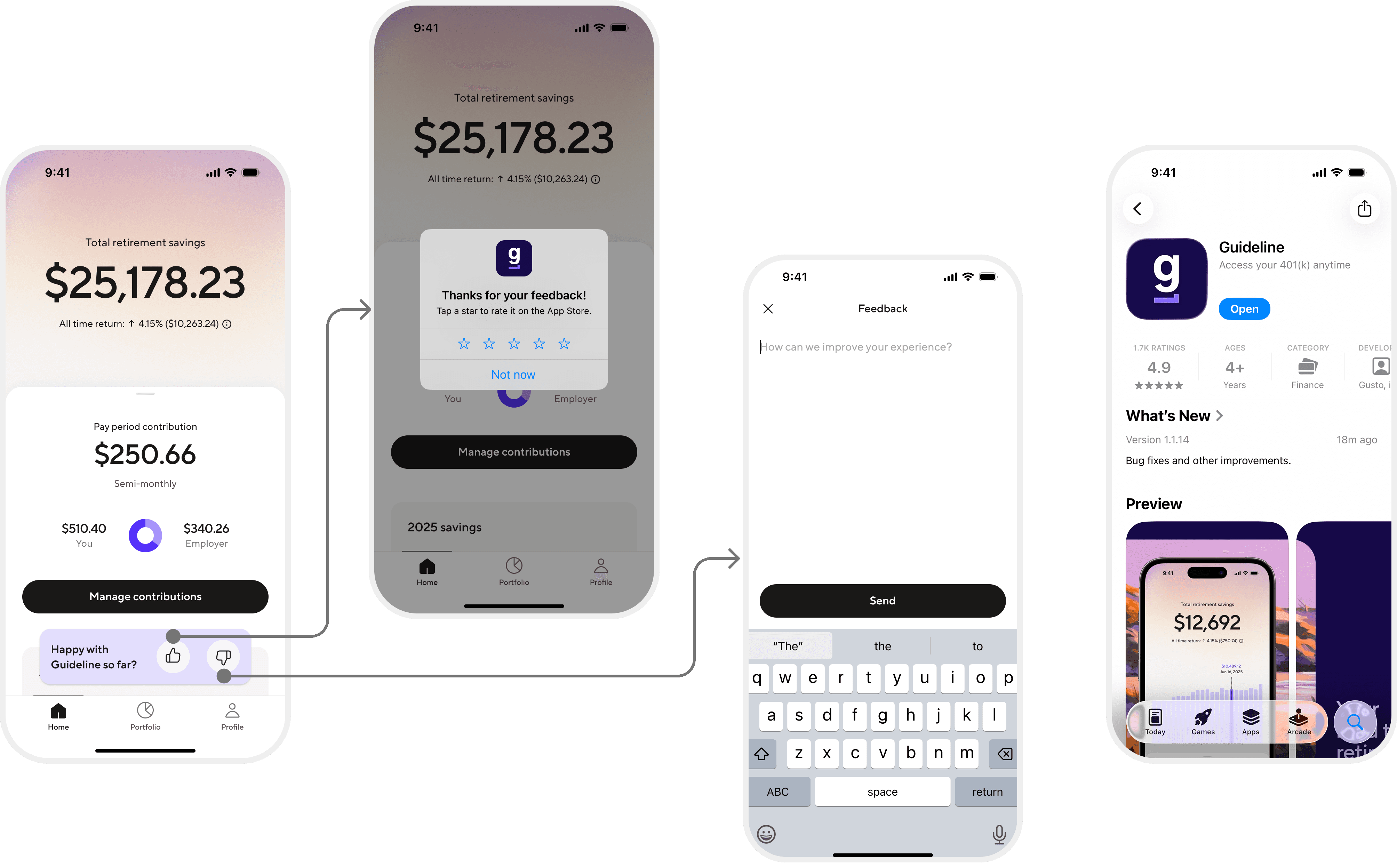
Improving store ratings became an immediate priority. Sub-4 ratings can undermine credibility, particularly in financial products where trust directly influences adoption. Rather than relying on passive review collection, I designed and launched an in-app sentiment capture system that strategically targeted engaged users.
The sentiment card triggered only after a user had authenticated five or more times, was at least 15 days post-onboarding, and had not seen the prompt in over 180 days if previously dismissed. Users who selected “thumbs up” were routed to the native App Store review dialog, while “thumbs down” opened a private feedback modal. This approach directed satisfied users toward public reviews while capturing negative sentiment internally before it surfaced as one-star feedback.
Within three months of release, ratings improved significantly: iOS increased from 3.8 to 4.9 and Android from 3.5 to 4.7. The improvement not only strengthened mobile credibility, but also reinforced trust.
Web parity (actions-based) navigation
Product-centric navigation
Multi-account and IRA support
At the time, the mobile app only supported a single 401(k) account, with limited functionality for users managing multiple retirement vehicles. I led the expansion to support multiple 401(k)s and IRAs, bringing mobile closer to web parity and unlocking engagement among users with more complex financial profiles.
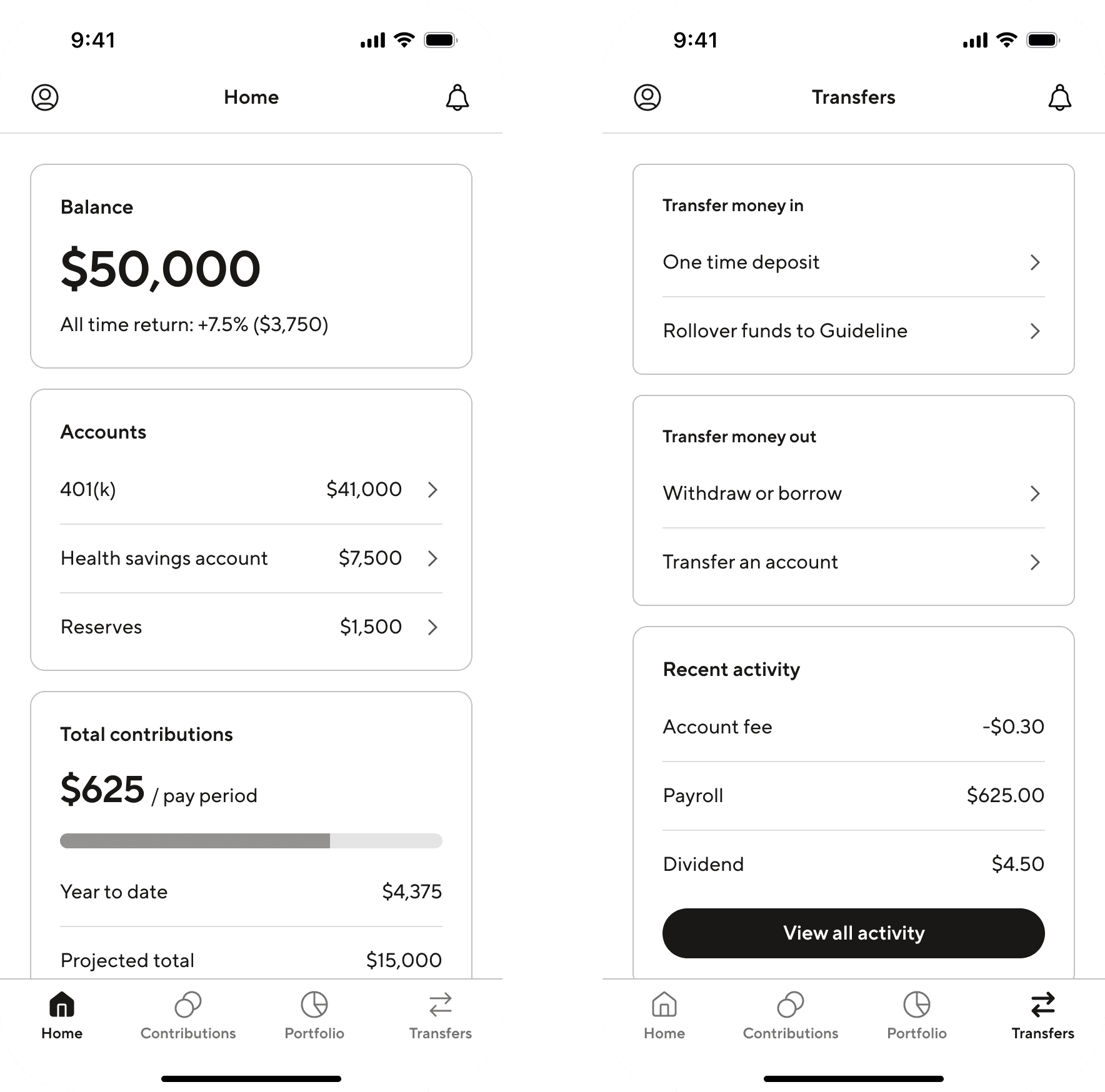
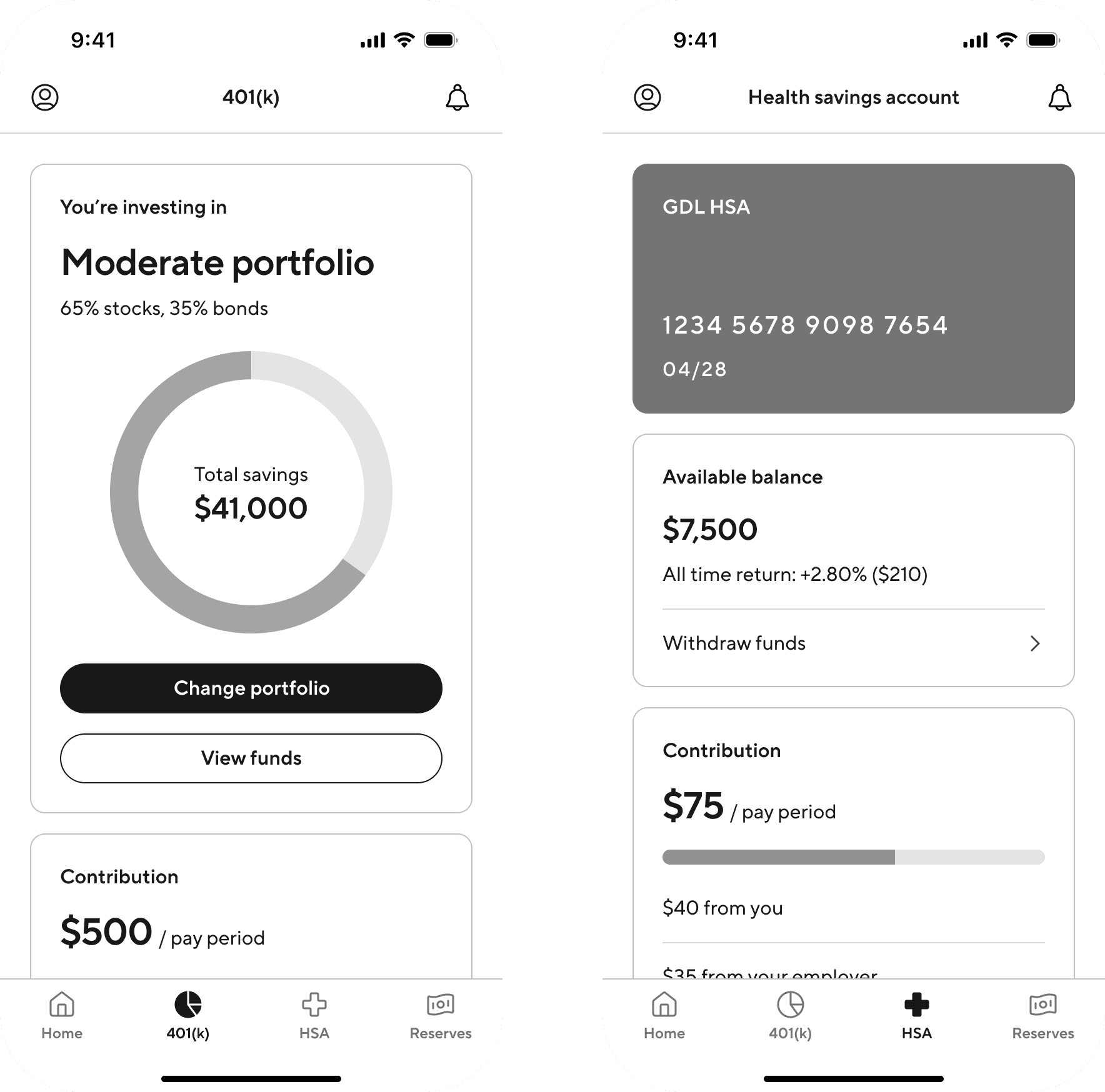
As part of this expansion, we re-evaluated the mobile navigation structure in anticipation of future product growth. I ran an unmoderated usability study comparing two bottom navigation models: one, web parity, aligned with our web product and organized around actions (Home, Contributions, Portfolio, Transfers), and another, product-centric, structured around individual products on the roadmap (Home, 401(k), HSA, Reserves). Eight of nine participants preferred the web-parity model, citing that action-based navigation felt more intuitive and appreciated having multiple paths to complete tasks.
While participants could successfully complete workflows in both concepts, the product-based model introduced a different mental model that added cognitive overhead. Based on these findings, we aligned mobile navigation with the web structure, ensuring consistency while creating a scalable foundation for future product expansion.
Dark mode and design systems
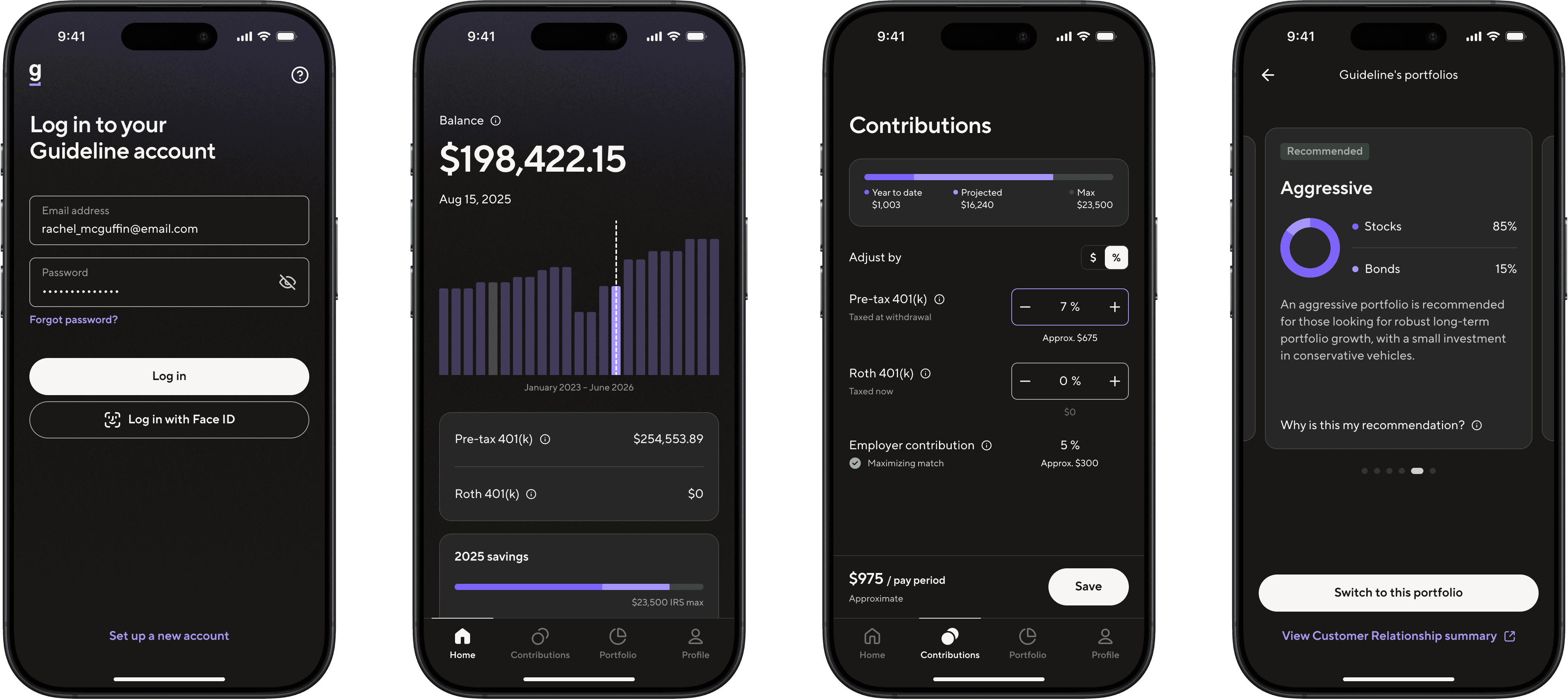
Dark mode was one of the most requested mobile features. Rather than treating it as a standalone enhancement, I used it as a strategic opportunity to bring the mobile apps into full alignment with Atlas, our web-first design system.
This required a comprehensive audit of every mobile screen, refactoring typography, spacing, color tokens, and iconography to match system standards while addressing accessibility gaps. Implementing dark mode meant theming the entire surface area of the app, not simply inverting colors. The result was a fully tokenized, system-consistent mobile experience that reduced design debt, improved maintainability, and modernized the product for long-term scale.
Outcomes
Over this period, the mobile apps transitioned from credibility risk to strategic asset. Store ratings rose to 4.9 on iOS and 4.7 on Android, feature parity expanded to support multi-account and IRA users, monthly engagement increased, and the apps achieved full design system alignment with dark mode support. Collectively, this work repositioned mobile from a maintenance channel to a mature, trusted extension of the Guideline platform.
Mobile app maturity and growth
Elevating credibility, feature parity, and consistency across Guideline's iOS and Android apps.
Client: Guideline
Role: Staff Product Designer
Date: Jan – Dec 2025
TL;DR
I led a comprehensive mobile maturity initiative that increased App Store ratings from sub-4.0 to 4.7+ while expanding feature parity and modernizing the design system foundation.
Overview
When I joined Guideline, the mobile app's adoption was steady but underperforming in perception and parity. App Store ratings sat below 4.0 (iOS: 3.8, Android: 3.5), the feature set lagged behind web, and the visual system was inconsistent with our newly launched Atlas design system. In fintech, credibility is critical: research consistently shows that users strongly prefer apps rated 4.0+ and that even small rating increases can materially impact download conversion and trust.
Over this time period, I led three parallel initiatives to improve perception, engagement, and product maturity:
Strategic ratings recovery
Multi-account + IRA expansion
Dark mode + full design system alignment
Mobile app experience audit
Before introducing new features, I proactively conducted a comprehensive audit of the entire mobile application, capturing and reviewing every screen. The goal was to identify design system inconsistencies, accessibility gaps, workflow friction, and long-standing usability issues. The audit revealed significant divergence from Atlas, our web design system, along with inconsistent typography, color usage, and interaction patterns across key user journeys.
Rather than treating these findings as isolated defects, I synthesized them into a structured quality framework and presented the opportunity space to product, engineering, and design stakeholders. From there, I partnered with my feature team to translate insights into a prioritized roadmap and created a clear engineering backlog to systematically address design debt and usability improvements. This established a shared quality baseline for mobile and positioned future work on a stronger, more scalable foundation.
Increasing App Store ratings
Improving store ratings became an immediate priority. Sub-4 ratings can undermine credibility, particularly in financial products where trust directly influences adoption. Rather than relying on passive review collection, I designed and launched an in-app sentiment capture system that strategically targeted engaged users.
The sentiment card triggered only after a user had authenticated five or more times, was at least 15 days post-onboarding, and had not seen the prompt in over 180 days if previously dismissed. Users who selected “thumbs up” were routed to the native App Store review dialog, while “thumbs down” opened a private feedback modal. This approach directed satisfied users toward public reviews while capturing negative sentiment internally before it surfaced as one-star feedback.
Within three months of release, ratings improved significantly: iOS increased from 3.8 to 4.9 and Android from 3.5 to 4.7. The improvement not only strengthened mobile credibility, but also reinforced trust.
Web parity (actions-based) navigation
Product-centric navigation
Multi-account and IRA support
At the time, the mobile app only supported a single 401(k) account, with limited functionality for users managing multiple retirement vehicles. I led the expansion to support multiple 401(k)s and IRAs, bringing mobile closer to web parity and unlocking engagement among users with more complex financial profiles.
As part of this expansion, we re-evaluated the mobile navigation structure in anticipation of future product growth. I ran an unmoderated usability study comparing two bottom navigation models: one, web parity, aligned with our web product and organized around actions (Home, Contributions, Portfolio, Transfers), and another, product-centric, structured around individual products on the roadmap (Home, 401(k), HSA, Reserves). Eight of nine participants preferred the web-parity model, citing that action-based navigation felt more intuitive and appreciated having multiple paths to complete tasks.
While participants could successfully complete workflows in both concepts, the product-based model introduced a different mental model that added cognitive overhead. Based on these findings, we aligned mobile navigation with the web structure, ensuring consistency while creating a scalable foundation for future product expansion.
Dark mode and design systems
Dark mode was one of the most requested mobile features. Rather than treating it as a standalone enhancement, I used it as a strategic opportunity to bring the mobile apps into full alignment with Atlas, our web-first design system.
This required a comprehensive audit of every mobile screen, refactoring typography, spacing, color tokens, and iconography to match system standards while addressing accessibility gaps. Implementing dark mode meant theming the entire surface area of the app, not simply inverting colors. The result was a fully tokenized, system-consistent mobile experience that reduced design debt, improved maintainability, and modernized the product for long-term scale.
Outcomes
Over this period, the mobile apps transitioned from credibility risk to strategic asset. Store ratings rose to 4.9 on iOS and 4.7 on Android, feature parity expanded to support multi-account and IRA users, monthly engagement increased, and the apps achieved full design system alignment with dark mode support. Collectively, this work repositioned mobile from a maintenance channel to a mature, trusted extension of the Guideline platform.